Doctor Berasategui
Legado en los huesosDoctor Berasategui is the hidden architect behind a series of murders initially mistaken for unrelated domestic crimes: using his position as a psychiatrist, he identifies men he can manipulate and steers their violence toward a larger design. His exposure as Doctor Yáñez connects the investigation’s recurring clues—the severed arms, the prison-cell message, and the men’s suicides—to one directing hand.
Identity and Background
For much of the investigation, Berasategui is known through the role of a doctor and a visitor whose identity is concealed. A photograph on a security pass lets Amaia recognize him as the mysterious visitor previously seen at Santa María de las Nieves. His name becomes more than a disguise when she addresses him as Doctor Yáñez: he is the son of Esteban Yáñez and Margarita Berasategui, and he took his mother’s surname as a tribute to her.
Amaia traces the significance of that family history to a childhood shaped by loss and rejection. Berasategui had been taken from his home after his mother died and rejected by the only person he had left. Margarita, she understands, had lived with depression; her home was orderly, with clean rooms, ironed clothes, and meals prepared, but also marked by silence and crying. Amaia presents this bleak domestic history not as an excuse for his actions, but as part of the origin she believes he has concealed behind his professional identity.
The Pattern Behind the Murders
The investigation first treated the amputations as possible crimes of opportunity: after Lucía Aguirre’s husband confessed to killing her, he denied having anything to do with the removal of her forearm. Amaia initially allowed that it might be incidental, perhaps an attempt to take a wedding ring or prevent identification. The same unexplained loss appeared in the case of Johana Márquez, raped and strangled by her stepfather, Jasón Medina, and in a third case in Logroño. In each, the victim’s arm had been severed at the elbow after death, with a sharp, toothed implement, and the limb was missing.
Other details turned resemblance into a signature. Medina and Ramón Quiralte each confessed to killing the woman close to them, then died by suicide, leaving similar messages. In prison, a word had been scratched into a wall with the handle of a toothbrush and painted over without filling the grooves: TARTTALO. The same unusual spelling, with two t’s, appeared in the Logroño case. Amaia reasoned that the detailed, repeated amputation was unlikely to have been copied from press reports, particularly because the detail in Johana’s case had been withheld from the public. The men’s domestic violence, impulsiveness, and—in some cases—alcohol or drug use fit familiar patterns of abuse; the post-mortem removal of the same arm and the shared message did not.
The cases had seemed isolated in part because the killers confessed and then died, allowing investigations to close before their evidence was compared across jurisdictions. Amaia also found two more women born in the valley who had been killed by partners, one in Bilbao and one in Burgos; obituaries for both had appeared in funeral homes in the valley, but the available records did not establish whether either woman had been mutilated. The scattered cases and incomplete information made the pattern harder to see, while also pointing toward a search beyond the individual men who had carried out the murders.
Recruitment and Control
Berasategui’s method depended on distinguishing men whose violence could be redirected from those whose behavior was too uncontrolled to command. Amaia’s profile of him describes an intelligent, highly educated psychiatrist who used professional access to find suitable targets, then manipulated them with the precision of a puppeteer, tightening or loosening his hold until their violence served his design. The men carried out the killings, but the recurring mutilation and messages suggested a separate hand shaping what happened around them.
Jasón Medina exposed the limits of that control. He had raped and strangled Johana Márquez, then returned home for a rope, intending to imitate a crime he had read about in the press. When he came back, her arm was gone. Medina had confessed to his own actions in tears and appeared genuinely perplexed when asked about the amputation; Amaia believed he was telling the truth. Unlike the other killers, he did not fit the pattern of a violent, intensely frustrated man with aggression held under pressure. The sexual violence was part of his own offending, but the missing arm was not. Amaia therefore reasoned that whoever took it must have been present at the right moment, and that Medina had been followed: a conclusion that made the apparently impulsive crime part of a planned pattern without pretending Medina himself had planned it.
The prison-treatment records offered a possible route by which Berasategui could identify and approach men like Medina and Quiralte. Both had attended therapy while imprisoned in Pamplona, and the supervision was associated with the University Clinic, which sent someone to the prison. Records from the Logroño case also showed that its prisoner had spoken with a psychiatrist, though the report named no individual and carried an illegible signature. Amaia later described a series of ghostlike prison reports bearing Sarasola’s signature but no psychiatrist’s name in the assigned-clinician field. The paperwork had passed as legitimate because it was signed by a head of psychiatry; its missing particulars concealed who had actually conducted the work.
Exposure and the Family Origin
Amaia encounters the final conspiracy not as an abstract pattern but in the cave, where Ibai lies within a complicated design of white salt or ash and candles. Rosario kneels beside him with a dagger, while Doctor Berasategui bends close, absorbed in the scene and reciting an unfamiliar, songlike passage. His presence beside the child turns the role of detached psychiatrist into direct participation in the ritual threat; Amaia enters armed, hears Ibai moving, and continues despite knowing that her old terror has returned.
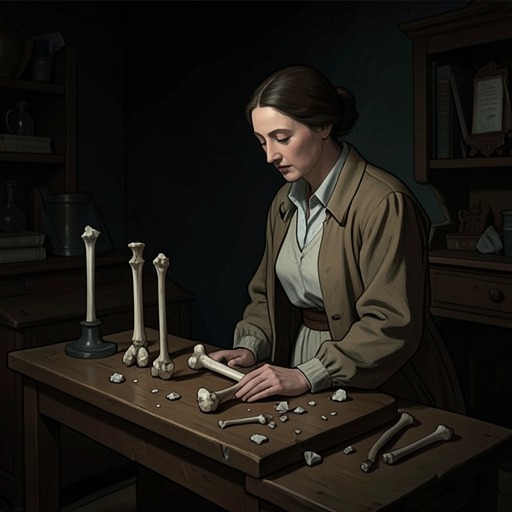
By the time Amaia confronts him in handcuffs, she names him Doctor Yáñez. She identifies him as the son of Esteban Yáñez and Margarita Berasategui, explaining that he adopted his mother’s surname as a tribute to her. Esteban, who cared for the garden around Amaia’s home, had found the family’s itxusuria and supplied bones to Garrido. Esteban said he did not know the bones would be used to desecrate a church and regarded taking them as a macabre prank on people he considered trespassers. The discovery links the family burial place to the desecration without making Esteban a knowing partner in Berasategui’s larger design.
Amaia frames her accusation through the investigation’s discordances: the victims were adult women from Baztán, while their killers had received anger-control therapy, giving Berasategui access to men he could direct. The contrast between the apparent perpetrators and the repeated, carefully arranged features of the crimes is what points beyond them. Berasategui denies being a manipulator, but the accusation is now anchored in the pattern, the prison records, the bones, and the scene in which he was found beside Ibai.
Limits of Control and the Case’s Discordance
Berasategui’s design was formidable but not complete. Amaia suspected that his arrival at the scene of Johana Márquez’s murder depended on contingency: a breakdown may have brought him to the workshop where Jasón Medina worked, and Johana may simply have crossed his path. She believed Berasategui had recognized that Medina could not be controlled. His sexual violence was driven by an immediate desire that overrode consequences, making him unlike the men whose aggression could be redirected; Medina’s impulsive crime therefore exposed a limit in the architect’s methods even as Berasategui exploited its aftermath.
That limit also shaped Amaia’s final reasoning. She followed what did not fit: not merely the similarities among the murders, but the mismatch between the men who confessed to them and the repeated, deliberate acts they could not explain. She called this the investigation’s discordance, while the family history supplied its origin. The principle turned Berasategui’s own carefully arranged pattern into evidence against him: the crimes pointed beyond their apparent perpetrators to someone who could locate, influence, and sometimes follow them, but whose reach was not absolute.
The Orchestrator’s Reach and Its Limits
Berasategui’s role extends beyond choosing men capable of violence: Amaia’s profile describes him directing their anger with calculated precision, persuading them to take their own lives and arranging a provocation that would lead to the desecration of a church. The murders’ apparent perpetrators thus become part of a larger design whose repeated details—the missing arms and the prison messages—were not simply echoes of their individual crimes. Berasategui shaped what followed them, turning separate acts of domestic violence into a pattern that concealed his own intervention.
The bones used in the church desecration expose both the reach and the limits of that manipulation. Esteban Yáñez, Berasategui’s father, supplied bones after finding the family’s Itxusuria, but said he had not known they would be used to profane a church; to him, taking them was a macabre prank against people he considered to be trespassing on his land. The distinction matters: Berasategui could draw his father into the chain of events without making him a knowing accomplice. Across the case, Amaia’s attention to what does not fit—the men’s varying profiles, the evidence they could not explain, and the acts arranged around their crimes—reveals the hidden organizer while showing that his control, however meticulous, was never total.
The Accusation and Its Immediate Effect
At the final confrontation, Doctor Berasategui listens without moving as Amaia sets out the discrepancy that has brought the investigation to him: the victims were adult women from Baztán, while their killers had received anger-control therapy, placing them within reach of someone able to identify and influence them. His lawyer asks whether she can prove the accusation, but Amaia keeps her attention on Berasategui’s face. When he quietly denies being a manipulator, the lawyer shifts away from him, as if putting an invisible barrier between them. The small movement leaves the denial exposed: the case against Berasategui rests not on a confession, but on the pattern of therapy, violence, and unexplained acts that his apparent proxies could not account for.
The Outlier in the Pattern
The selection of victims supplied a further test of Amaia Salazar’s theory. In the other cases she considered, the murdered women had been born in the Baztán Valley but were living elsewhere: one had moved because an earlier generation settled in another province, another through marriage, and another after her abuser isolated her from her family. Johana Márquez broke that pattern. She had not been born in the valley and was the only victim living there when she died. Her case therefore matched the series in some respects while departing from its apparent geography.
The offender also differed. Jasón Medina had no known history of violence and did not fit the pressure-cooker profile Amaia saw in the other killers. His abuse of Johana included sexual violence, but Amaia distinguished that from a broader, established pattern of aggression: Medina’s violence emerged in the sexual offense, not from the same accumulated hostility attributed to the others. Those discrepancies made the case harder to explain as a straightforward recruitment. They sharpened the distinction between the men who committed the murders and the person Amaia believed was connecting them, while showing that the pattern was not a perfectly uniform template.